Abraham Lincoln
This page about President Abraham Lincoln.
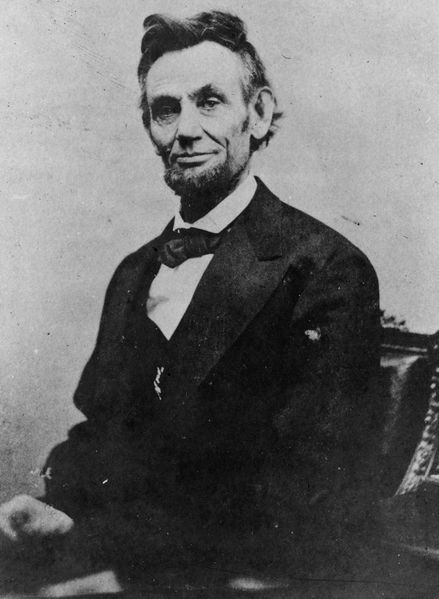
Abraham Lincoln, was born in a log cabin at Hodgenville, on February 12 1809 and died at Washington on April 15 1865. Lincoln was the 16th President of the United States, and the first president elected belonging to the Republican party. He is considered by historians and the public alike one of the most important and popular presidents of the United States.
Abraham Lincoln was the president who ended slavery, first with the Emancipation Proclamation (1863), which freed slaves in the territories at war with the Union, and later with the ratification of the Thirteenth Amendment of the U.S. Constitution in 1864, by which slavery was permanently abolished in the United States. A Lincoln is credited with having simultaneously preserved the federal unity of the nation, defeated the Confederate States of America (which favored the maintenance of slavery) in the American Civil War.
Lincoln had a lasting influence on political and social institutions of the United States, beginning a greater centralization of power by the federal government and placing a limit to the autonomy of the governments of individual states. The authority of Lincoln was reinforced by his skill as an orator, and the Gettysburg Address, the most significant and famous of his speeches, is considered one of the cornerstones of unity and values of the American nation.
Some supporters of "states' rights" (especially those who looked with favor on the positions of the Confederates), considered Lincoln to be overly authoritative and criticized him for suspending civil liberty and the privacy of the vote, executing protesters against the war, and suppressing the legitimate right of state secession. Other critics point to his apparent belief in white supremacy, despite his opposition to slavery (see Lincoln-Douglas debates of 1858) and his initial support for slavery.
Despite these critics, Lincoln is generally regarded as one of the best Presidents that the United States has ever had. He is also widely regarded as a force for good, who did what had to be done the nation from the moral cancer of slavery, and disintegration.
Lincoln's Youth
Lincoln was born on February 12 of 1809, on a farm in Nolin Creek, Kentucky, to Thomas Lincoln and Nancy Hanks, two farmers with no formal education. His biological mother died when Lincoln was 9 years old and Lincoln was raised by his step-mother Sarah Bush Johnston, who loved him. Lincoln rarely attended school and in his life had less than 1 year of formal schooling. Despite this, Lincoln learned to read (he was largely self-taught) and loved books. He read the Bible, the history of England and the United States. Among the books he had read, were Robinson Crusoe by Daniel Defoe, and the Fables of Aesop. His neighbors would later recount that Lincoln was inclined to travel miles to go and borrow a book.
Until he was nineteen years old Lincoln helped his father with the farm work, and led the hard life of the pioneer on the frontier. In 1830 the Lincolns moved once more to the west, to Macon County in Illinois. Shortly thereafter, Abraham left home and settled down in the prairie town of New Salem, Illinois, where he worked in the next few years as a merchant, surveyor and postmaster. Lincoln received almost no formal schooling, and was largely self-taught.
Abraham Lincoln first became acquainted with urban America when he got work as a rafter, driving cargoes from the Ohio and Mississippi Rivers downstream to New Orleans. It was during one of these trips that Lincoln observed first hand the inhumanity of slavery, and which would lead to his life-long opposition to the institution.
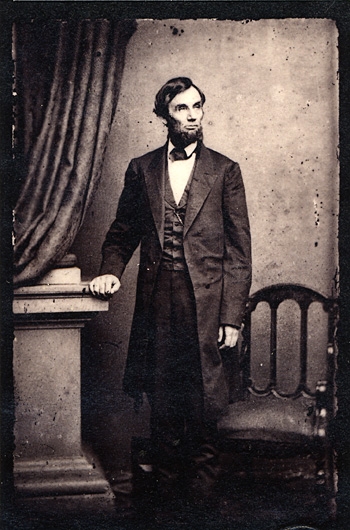
In 1832, Lincoln fought as a volunteer in the Black Hawk War, which pitted the American colonists against the Sauk Indians. Lincoln did not see any combat but his comrades elected him to the rank of captain. This and the fact that he was in a debating society in New Salem where he proved to be a good speaker, encouraged Lincoln to be a candidate for the Illinois House of Representatives that same year. As a supporter of the liberal-conservative Whig Party, Lincoln joined the campaign for the expansion of infrastructure and improving the school system. Lincoln was defeated at his first attempt to gain public office, but he was elected in 1834 and was reelected four times until 1842.
During his term in office, Lincoln gained the nickname of "Honest Abe" which would stay with him for life. His debating skills soon led to Lincoln being elected speaker of the Finance Committee and, at the young age of 27 years, party leader of the opposition Whigs. His first public statement against slavery dates to 1837. In a parliamentary debate, Lincoln noted, that the institution of slavery was based on "on injustice and bad policy."
In the first years of his political career Lincoln completed a disciplined self-study of law; 1836 he was admitted to the Bar Association of Illinois. The following year he founded with another lawyer, John T. Stuart, a law practice in the new capital of Illinois, Springfield. But even as a lawyer, for a long time Lincoln lived in extremely modest circumstances. However, Lincoln's skill as an orator earned him a great reputation as a lawyer and people flocked to hear him when he appeared in court. As Lincoln's reputation grew, he was asked to represent clients in precedent setting cases.
Lincoln was tall (1.93 meters), even by today's standards, and he was exceptionally tall compared to the average height of men in that era. He had thick black hair and a big nose and big ears. Although Abraham Lincoln is always depicted as having a beard, he did not grow one until later in life.
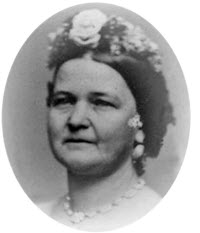
Mary Todd Lincoln |
Lincoln had little luck with women. He lost his first love, Anne Rutledge when she died, probably of typhoid. He then courted Mary Owens, the sister of his friend Elizabeth Abell. Lincoln made his marriage proposal to Owens in May 1837, but she refused. Eighteen months later, he became engaged to Mary Todd who came from a wealthy family of planters and slaveholders from Kentucky. Her family were opposed to their marriage because of his views on slavery and his lack of financial means. However, Mary Todd and Lincoln were married in 1842, despite the resistance of her family. The Lincolns had four sons: Robert, Edward, William and Thomas. Edward and William died in childhood or in Lincoln's lifetime, Thomas in 1871 in the age of 18 years. Only Robert Todd Lincoln reached adulthood. Like his father, he took a career as a lawyer and politician. The last direct descendant of Abraham Lincoln, a great-grandson, died in 1985. According to many accounts, the marriage between Mary and Lincoln was not a happy one. |
Lincoln as Member of the House of Representatives
After his wedding Lincoln retired from the state legislature of Illinois, to devote himself increasingly to his law practice. He earned a reputation as a specialist in railroad law, and came gradually to modest prosperity.
When Illinois was admitted as a state, Lincoln returned to politics and was elected to the U.S. House of Representatives.
In Washington, Lincoln an opponent of President James K. Polk and his war policy against Mexico. In addition, he brought on a half-hearted resolution on the restriction of slavery in the District of Columbia. Otherwise, on his first appearance in federal politics, Lincoln was hardly talked about.
Lincoln was living without his family while in Washington, and the idea of a career in federal politics did not entice him. In 1849, the new President, Zachary Taylor, offered Lincoln to be governor of the new territory of Oregon, which included the present states of Oregon, Washington and Idaho and parts of Montana. Lincoln refused and in 1849 he went back to Springfield. For the next five years Abraham Lincoln was out of politics. Only the deterioration of the slavery question brought him back onto the political stage.
Abraham Lincoln's Road to Presidency
To understand how Abraham Lincoln, a little known politician from Illinois to be the Presidential candidate for the newly formed Republican Party, it is necessary to consider the issue of slavery in American politics at the time, and Lincoln's position towards this great evil.
The worsening of the slavery question
Socially, economically and culturally the northern and southern parts of the United States had always been different. One of the great distinctions between the north and the south was slavery: the northern states did not allow slavery, while the southern states not only allowed it, they were dependent upon it for their economic prosperity. In the United States, the slaves were descended from African men and women who had been forcibly kidnapped and brought to America to work for White owners. Slaves worked primarily as farm hands but also held positions as domestic servants, drivers and artisans. The way that slaves were treated varied from owner to owner, but as a whole slaves were treated as property and often no better than cattle. Slaves could be sold and separated from their wives and children, and they could be subjected to physical cruelty and even killed by their masters. Slavery was an institution that ate at the moral fibre of the nation.
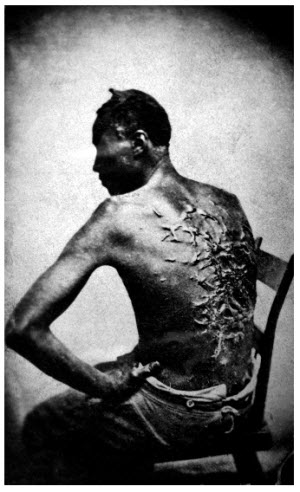
The Evil of Slavery. This is a photograph of an American slave scarred from being whipped by his oversear. |
As the nation expanded westward the question arose whether the newly formed states of the union would allow slavery or not. Those who opposed slavery did not want more slave owning states admitted to the Union, while the South wanted the new states to permit slavery since the more states that allowed it, the less likely the northerners would be able to ban slavery throughout the country. Despite its smaller population, the South with its rich planter aristocracy, took on a leadership role in the politics of the time. The number of members that a state could send to the national assembly depended on the size of its population. The North had a greater population than the south. In an attempt to balance the scales, a compromise had been reached whereby the slaves in the southern states were counted as three-fifths of a person, for the purpose of appointing members to the House of Representatives. While the slaves were counted, they were of course denied the right to vote. Since the beginning of the 19th century, however, even this means of increasing the voting power of the southern states had begun to give way in the face of the ever increasing population of the North. The southern states were increasingly concerned that they were losing their dominant position in the politics of the nation, and they feared that the North would seek to impose their opposition to slavery upon them by making it illegal. As the south lost control of federal politics, it came to regard the federal government as interfering. Southern states advocated the concept of state rights, which was based on a theory of federalism in which each state was essentially an independent country, and the national government had few if any powers. |
The interests of the two economies could be completely contradictory to each other harder and harder to reconcile. The South, dependent on agricultural land and the export of cotton, tobacco and other plantation products, championed free trade policy. The North, which wanted to protect its fledgling industries against imports of bulk products from England, was in favor of the highest possible tariff protection. The Democratic Party, which was traditionally strong in the South was in favor of a high degree of autonomy of the individual states, which would allow the newly formed states to decide whether or not to permit slavery. However, Lincoln's party, the Whigs (and later), the Republican Party, argued for a strong central power in Washington and to the principle of free labor in the re-colonize areas of the West.
Each new state that was admitted to the Union also changed the balance of power in the senate, where each state had an equal number of senators regardless of population. Free and slave states were increasingly anxious, to not let the other side in the Senate get in the minority. This problem arose again and again whenever a new state should be admitted to the Union. The conflict could be defused 1820 by the Missouri Compromise. It provided that slavery north of the Mason-Dixon line, which ran at about 36 ° 30 'north latitude, should be banned in all new states except Missouri. The large territorial gains by the United States 1848 during the Mexican-American War made south of this line, threatened to move the balance again in favor of the South, as it was anticipated that new states would be admitted south of the Mason-Dixon line, and that these states would therefore be slave states. The Compromise of 1850 gave Congress, however, one more chance to compensate for the differences.
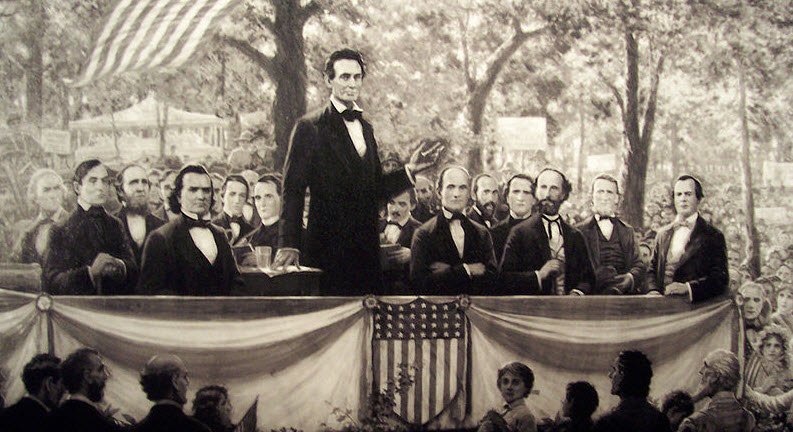 |
| Lincoln Debating Stephen Douglas. |
In May 1854 the Kansas-Nebraska act was adopted at the request of Democratic Senator Stephen A. Douglas, a later political opponent of Abraham Lincoln. opened these two territories to slavery (and therefore set aside the limits to the spread of slavery that were part of the Missouri Compromise of 1820). As an opponent of slavery, Lincoln saw this as an immoral act, and he was motivated to return to politics. His speeches against the Kansas-Nebraska Act which he gave on October 16 1854 in Peoria, drew large crowds. In Kansas an armed conflict sometimes referred to as a "civil war before the Civil War" broke out over this issue. Slavery advocates fought with Free Soilers, who argued for the principle of free labor in the open country. The de facto repeal of the Missouri Compromise aroused a storm of indignation throughout the North.
Lincoln as a moderate opponent of slavery
The dispute over the new law broke apart the Whig Party. During 1854, the majority of its members, including Lincoln, joined with moderate abolitionists from the ranks of Democrats, and with radical abolitionists, who demanded an immediate ban of slavery, along with several other groups to form the new Republican Party.
At that time, Lincoln was not a passionate opponent of slavery. He hated it on moral grounds but did not forcefully advocate for its abolition entirely. Lincoln was of the view that the founding fathers of the United States generally regarded slavery as evil, but that they had tolerated it for pragmatic reasons. As a result Lincoln felt that slavery should be allowed to continue in those states where it had existed at the time of the Declaration of Independence of 1776 and the date of adoption of the U.S. Constitution by 1787. However he regarded the extension of slavery to other states and territories, to be contrary to the spirit of the Constitution and the liberal principles of the American Revolution.
In the early years of the Republic many politicians -- such as George Washington and Thomas Jefferson -- who had actually been slaveholders, shared this view. However, since the beginning of the 19th century, the voices of apologists of slavery became louder in the South. They defended not only maintaining slavery, but called for its further expansion. With the Kansas-Nebraska Act, slavery proponents seemed to go on the offensive. It was these events that spurred Lincoln to return to politics.
In 1855, Lincoln failed in his first attempt failed to gain a seat in the Senate. Three years later he made a second attempt. His opponent was Stephen A. Douglas, leader of the Democrats at the federal level, who known as a great orator. The two campaigned throughout the state and engaged in a number of debates, which were not only attended by thousands, but were also reported in the national newspapers. Lincoln again lost the election to the Senate, but he had made himself a name as a moderate opponent of slavery throughout the country a name and was considered a serious candidate for President by the Republicans in the next presidential election.
In a famous speech, known as the "House Divided Speech", which he gave on June 16, 1858, Lincoln brought the issue of slavery and its impact on American politics once more to the point:
A house divided against itself cannot stand." I believe this government cannot endure, permanently, half slave and half free. I do not expect the Union to be dissolved — I do not expect the house to fall — but I do expect it will cease to be divided. It will become all one thing or all the other.
Either the opponents of slavery will arrest the further spread of it, and place it where the public mind shall rest in the belief that it is in the course of ultimate extinction; or its advocates will push it forward, till it shall become alike lawful in all the States, old as well as new — North as well as South.
The Presidential Election of 1860
During 1859 Lincoln undertook lecture tours throughout the northern states in order to introduce himself and his policies to the public. At the nominating convention of the Republicans in Chicago, he would eventually prevail against the original favorite William H. Seward from the state of New York and other strong candidates such as Salmon P. Chase of Ohio, and Simon Cameron of Pennsylvania. Later, he took them all into his cabinet and forced the leaders of the various intra-party factions to work together instead of working against each other.
On May 18, 1860 the Republicans chose Abraham Lincoln to be their presidential candidates for the struggle for the White House. Lincoln's campaign song, which succinctly summed up his program, was the popular song called "Lincoln and Liberty". During the campaign, Lincoln made good use of high rhetorical talent. He was considered one of the greatest orators of his time and many of his sayings and aphorisms are quoted even today. Above all, Lincoln knew how to explain complex issues in simple terms and to the point. Sentences like "Nothing is settled, what is unjustly settled," "the campaign promises of today are tomorrow's taxes," convinced many voters.
The presidential election was held in the autumn. The foundation for Lincoln's victory had been placed two years earlier in the debates with Stephen A. Douglas. Douglas was now seeking the nomination of the Democratic Party, but during his debates with Lincoln, Douglas had been forced to take a position on the issue of slavery, and he had spoken against it. This made Douglas ineligible for the nomination in the eyes of the southern Democrats. Like the Whigs six years earlier, the issue of slavery was splitting the Democratic party.
The northern Democrats nominated Douglas, the Southern Democrats, chose the slavery advocates John C. Breckinridge of Kentucky, who was at this time acting Vice-President. Together they received 2.2 million votes, John Bell from Tennessee, who took the split-off from the Whigs Constitutional Union Party, another 0.6 million; Lincoln, with 1.9 million votes, emerged as the strongest single strongest candidate. Lincoln lost in all of the constituencies of the South - in the majority, he was not even on the ballot - but received almost all the electoral vote of the North (180) and thus a clear majority. On November 4, 1860 Abraham Lincoln was elected president. He was to be sworn in on March 4, 1861.
Abraham Lincoln as President
Lincoln became President of a "house divided". The secession of the Southern States and the beginning of the American Civil War began just as he took office.
Throughout his tenure as U.S. President Abraham Lincoln was forced to wage a civil war to restore the Union. He had four major tasks: He must win the war militarily, maintain the North's the willingness to fight, prevent the interference of European powers in favor of the Confederates, and ultimately, by achieving the abolition of slavery, eliminate the cause of the conflict once and for all.
Taking Office and the Outbreak of the Civil War.
|
Lincoln was President of a deeply divided country, torn over the issue of slavery and the role the federal government versus the rights of the individual states. At stake was whether the United States would have a strong central government or whether it would be a relatively loose association, a confederacy, of independent states. Also at stake, was the moral direction of the nation, and whether the nation would continue the sin of slavery. Soon after Lincoln took office, the crisis that led to the Civil War began. Lincoln had to travel from Illinois to Washington in order to be sworn in. While traveling to his destination, Lincoln survived an assassination attempt in Baltimore, and on February 23 1861 he arrived in Washington in secret and in disguise. Southerners ridiculed Lincoln for this alleged act of cowardice. |
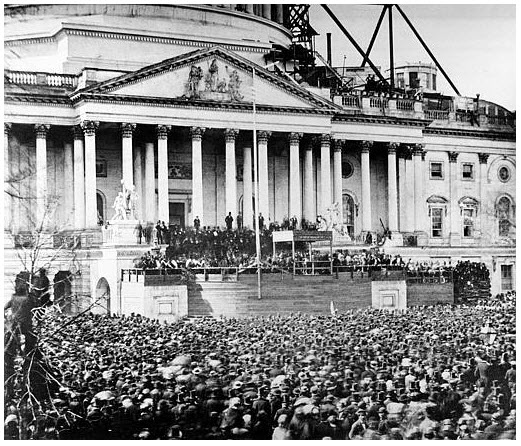
Lincoln's First Inauguration |
Even before Lincoln took office, the Southern states had withdrawn from the Union. A Civil War was imminent. The election of Abraham Lincoln was not the cause but the occasion of the secession. Since about 1850, many in the South had advocated a withdrawal from the Union. Criticism in the north of slavery was seen as a threat to one's lifestyle and culture and any attempt to restrict slavery was regarded in the South as an interference with the rights of individual states and in the property rights of its citizens. Due to this view, the proponents of secession made no distinction between the spirit of compromise, the objectives of Lincoln and other abolitionists.
The prospect of seeing Lincoln in the White House, gave the extremists in the south the last decisive boost. Even before the new president could take office, South Carolina resigned from the Union on December 20, 1860. Within weeks, it was followed by Georgia , Florida , Alabama , Louisiana , Mississippi, and on February 22, 1861 by Texas.
In Montgomery, the capital of Alabama, the Southern states proclaimed the Confederate States of America and chose Jefferson Davies, the senator from Mississippi and former Minister of War to be their provisional President. The outgoing U.S. President James Buchanan challenged the states right to leave the Union in his last weeks in office but did nothing to prevent secession.
In his inaugural address delivered on March 4, 1861, Abraham Lincoln struck a conciliatory tone towards the south. He promised not to resort to violence as a first action, but also made clear that his oath of office required him to oppose a split in the Union in any case:
In your hands, my dissatisfied fellow-countrymen, and not in mine, is the momentous issue of civil war. The Government will not assail you. You can have no conflict without being yourselves the aggressors. You have no oath registered in heaven to destroy the Government, while I shall have the most solemn one to "preserve, protect, and defend it."
I am loath to close. We are not enemies, but friends. We must not be enemies. Though passion may have strained it must not break our bonds of affection. The mystic chords of memory, stretching from every battlefield and patriot grave to every living heart and hearthstone all over this broad land, will yet swell the chorus of the Union, when again touched, as surely they will be, by the better angels of our nature.
|
All hopes of a negotiated settlement were dashed, however, on April 12, 1861. On this day, Confederate forces began to bombard Fort Sumter, which was lay in the harbor entrance of Charleston, the old capital of South Carolina, and which was held by federal forces. From the south's perspective, the presence of a federal military garrison within their territory was a provocation. The South regarded the garrison of Fort Sumter as an occupation force, so despite the offered non-violence it resorted to arms. The forced withdrawal of the garrison of Fort Sumter on April 14, now produced in the North, a war atmosphere. The public demanded vigorous action against the "rebels". In a speech four years later, Lincoln had this to say about the events of Fort Sumter: |
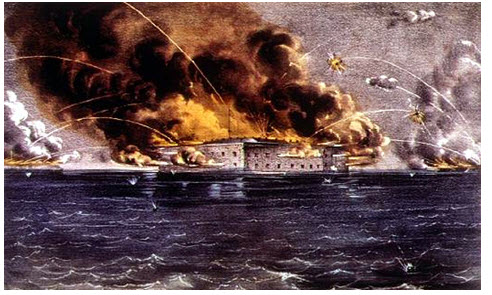
The Start of the Civil War: The Attack on Fort Sumter |
Both parties deprecated war; but one of them would make war rather than let the nation survive; and the other would accept war rather than let it perish. And the war came
The beginning of hostilities led Virginia and three other states of the upper South - North Carolina, Tennessee and Arkansas - to leave the Union now as well. The Confederacy then moved its capital to Richmond, Virginia. From this state in turn separated the western parts of the Virginia who wanted to remain in the Union.
To defend Washington, it was viewed in the north of crucial importance that the slave-holding border states of Delaware, Maryland, Kentucky and Missouri, remain in the Union. On this issue Lincoln stated: "I hope to have God on my side, but I must have Kentucky." All four states ultimately remained loyal - sometimes voluntarily, sometimes under military pressure.
Lincoln's policies in the war
At the beginning of the war, the U.S. Army had only just over 16,000 soldiers who were also mostly stationed in the Indian territories of the West. Am 15. On 15 April, one day after the fall of Fort Sumter, Lincoln called for 75,000 recruits. As a further emergency measure, Lincoln ordered a naval blockade of Confederate ports, and increased U.S. forces by early summer with the further recruitment of around 174,000 soldiers and sailors.
The war measures taken by Lincoln were made without Congressional approval, since Congress did not meet until July. Lincoln, on his own initiative, restricted civil liberties to deal with the emergency. He suspended the right of Habeas corpus, and suspended the rights of freedom of the press. People suspected of espionage on behalf of the South were held without warrant or trial. These actions earned Lincoln a reputation as a dictator in the eyes of southern sympathizers. But when, in July, the representative of the remaining states in the Union met, they voted all the emergency actions of the president had sought, and which he had already been exercising.
The first defeat of the Union troops in the Battle of Bull Run on July 21 made it clear that there would not be any quick military solution. The losses suffered by the Union Army also convinced Lincoln and his cabinet that the war could not be won with only a small army of volunteers. The Union had to adapt and fight a protracted war against a determined rebellion. Lincoln therefore instituted the first draft and conscripted thousands of men to fight in the army. This measure proved very unpopular and ed to civil unrest in July 1863 in New York during the so-called Draft Riots. In the city of New York there were times even attempts to secede from the Union and also constitute a sovereign state.
The Civil War dragged on without a decisive victory, mainly because Lincoln did not have a suitable commander for the Army of the Potomac, which had to bear the brunt of the fighting in the border area of Virginia, between Washington and Richmond. General George B. McClellan turned to be a superb organizer, but a reluctant commander. He missed - such as the Peninsula Campaign in spring 1862 - several chances to achieve a tangible victory and bring the war to an early end. Other commanders, such as Ambrose E. Burnside and Joseph Hooker suffered disastrous defeats against the outnumbered Confederate Army of Northern Virginia, led by General Robert E. Lee.
Abraham Lincoln's only military experience, before becoming the commander in chief of the United States was as a company commander in the Black Hawk War against the Indians. Just as he had done with the study of law, Lincoln immediately began a program of self study, and soon became an expert in military matters. Lincoln personally directed the war against the South. He also finally appointed competent commanders to lead the Army to victory: Ulysses S. Grant and William T. Sherman
War Aims
Publisher Horace Greeley, an opponent of slavery, exerted considerable influence on public opinion in the North.On August 22, 1862 Lincoln wrote an open letter to the New York Tribune, the newspaper of the famous New York abolitionist Horace Greeley:
"My primary goal in this war is to save the Union, it is not to save or destroy slavery. If I could save the Union without freeing even a slave, I would do it. If I could save it by freeing all the slaves, I would do it, and if I could save the Union by freeing some slaves and others do not, then would I do that too. Everything I do in terms of slavery and the blacks, is because I believe that it helps to save the Union. "
The question which had sparked the fight, was: does a single state in the U.S. have the right to withdraw at any time from the common union? The South answered in the affirmative, arguing that they had voluntarily joined the federal government and therefore could voluntarily leave it. The Confederates also fought for their own understanding for the rights of individual states.
The North pointed out, however, that none of the individual states' rights had been violated before the Southern states had seceded, and that the revolution of 1776 had only been justified after continued, serious, violations by the British. The deeper reason, however, was touched on by Abraham Lincoln in the Gettysburg Address of 1863. In this speech, his most famous, he said the war was being fought over the question of whether a state, based on democracy and founded on individual liberty could ever exist in the long run. Lincoln famously referred to such a government as a "government of the people, by the people and for the people and expressed his conviction that a democracy would fail if a minority (as the Southerners) could reject the democratic decision of the majority at any time, by ignoring it or even resorting to violence.
Behind the question of states' rights, was the question of slavery. It was the issue of slavery that had inflamed the issue of states' rights. Without it, the problem of states' rights would never have been fought with the same severity. Lincoln, for political reasons, long denied that the abolition of slavery was one of his war aims. At the beginning of the conflict, the abolitionists in the North were still a minority, hardly anyone would have been willing to consider the liberation of slaves to be worth the fight. Yet Lincoln had already been initiated the process that would culminate in freedom for the slaves, as he wrote the letter quoted to Greeley.
The Emancipation Proclamation
|
Lincoln was never a radical abolitionist, even during the war. In the famous letter to Greeley, he distinguished between his personal wish that all people should be free, and his duty as a public official, to act according to law and order. Under the law, slavery was permitted in the south. According to Lincoln, slavery should be abolished in a gradual process and the slaveholders compensated for the loss of their "property". However, the longer the war lasted and the more victims it claimed, the stronger was Lincoln's belief that slavery should be abolished as the source of all evil. Moreover, Lincoln realized that the abolition of slavery would serve to weaken the South economically and militarily. July 22, 1862 Lincoln informed his cabinet of the proposed proclamation, which would proclaim the slaves in the Southern states (but not those in the friendly slave-holding states) to be free. Since the abolition of slavery was also intended as a war measure, Secretary of State Seward noted that the statement could be interpreted as a sign of weakness if it was made then, so soon after a series of heavy Union defeats. Therefore, Lincoln's proclamation was announced only in September, after the Union victory in the Battle of Antietam. |
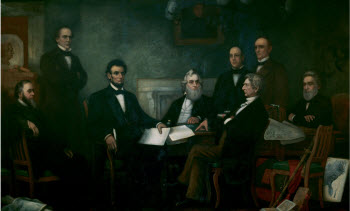
Lincoln Reading the Emancipation Proclamation |
On January 1, 1863 the Emancipation Proclamation finally came into force. The key passage read:
That on the 1st day of January, A.D. 1863, all persons held as slaves within any State or designated part of a State the people whereof shall then be in rebellion against the United States shall be then, thenceforward, and forever free ....
The proclamation was thus at first applicable only to the territories of the Confederacy, so as not to alienate the loyal slave states that remained in the Union. But the liberation of the slaves was now an official war aims of the Union. The moral weight of this Proclamation made it impossible for England and France, which supported the Confederacy for economic and geopolitical reasons, to actively intervene in the war on the side of the Confederate States. To do so would have been to clearly support slavery, even though slavery had already been abolished in both England and France.
Lincoln later said of the Emancipation Proclamation: "I have never in my life, felt more certain of doing the right thing, than when I signed that document." However, though Lincoln hated the institution of slavery, his views towards African Americans were not so liberal or advanced. On the subject of racial equality, Lincoln had stated:
I will say, then, that I AM NOT NOR HAVE EVER BEEN in favor of bringing about in any way the social and political equality of the black and white races---that I am not, nor ever have been, in favor of making voters or jurors of negroes, nor of qualifying them to hold office, nor to intermarry with White people; and I will say in addition to this that there is a physical difference between the White and black races which will ever FORBID the two races living together on terms of social and political equality. And inasmuch as they cannot so live, while they do remain together, there must be the position of superior and inferior, and I, as much as any other man, am in favor of having the superior position assigned to the White race."
— 4th Lincoln-Douglas debate, September 18th, 1858; COLLECTED WORKS Vol. 3, pp. 145-146
Re-election, victory and death
After their defeat at the Battle of Gettysburg, in July 1863, the Confederates were not in a position to win the war. Their only chance was to prolong the war so long and continue to inflict such costly losses upon the North that Abraham Lincoln would lose Presidential elections in 1864 he would be replaced by a new president who would be willing to negotiate.
General Ulysses S. Grant
|
This chance was very real. The unexpectedly long and bloody war of position, led by General Grant since the spring of 1864 in Northern Virginia, cost the government and Lincoln the confidence of the population. In the summer of the election year the President and his running mate Andrew Johnson were so unpopular that Lincoln was expecting a defeat. In a memorandum dated August 23, 1864 he wrote: "The re-election of this government now seems in the last few days, as highly unlikely." His opponent from the Democrats was his former commander McClellan, who was willing in principle to reach a negotiated peace with the south and to recognize its independence. |
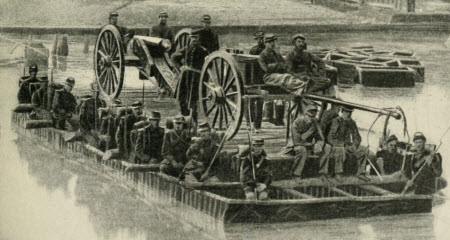 Union artillery and infantry cross the Chattahoochee River in a canvas pontoon boat, 1864 |
Only in the final weeks before the election, did the tide turn, when the results of the highly successful Atlanta campaign were announced: On September 2, 1864, General Sherman's troops entered Atlanta, the capital of the rebel State of Georgia. Between them and Virginia there were only weak Confederate forces. Moreover, on October 19, Major General Philip Sheridan defeated in the Shenandoah Valley, a Confederate corps, which had at times even threatened Washington. It now seemed that it was only a matter of time before the North would be victorious.
Capitalizing on these successes, the Republicans adopted a campaign slogan coined by Lincoln: "You do not change horses in the middle of a river," implying that it was the wrong time to change leaders, and that the country should stick with Lincoln because they were halfway to Victory. The Lincoln campaign also described the Democrat's willingness to negotiate and to split the Union as traitorous. The campaign strategy worked and on November 8, 55 percent of the electorate voted for him, and he won 212 of 233 electoral votes. Lincoln became the first president in 32 years to be confirmed for a second term. It had been a close call, and it can be said that if Lincoln had been defeated in the election, the United States would certainly have been a different country, and quite possibly there would have been two United States. The effect that this weakening of American power would have had on the course of future history is impossible to measure. Would the Allies have won the First World War? Would there have been an arsenal of democracy to help Britain hold out against the Nazis? Would Russia have won the Cold War? On events such as these hang the fate of nations and even the world.
In this election, Lincoln's votes came from the farmers and workers and the urban middle classes. He did best in New England and the States with a high proportion of German immigrants, such as Wisconsin and Illinois. For the president it was particularly important that the soldiers of the Union army had voted more than two-thirds for him, though they could hope to gain from a victory McClellan a quicker end to the fighting.
In the period leading up to his second inauguration Lincoln worked vigorously for the adoption of the 13th Amendment to the U.S. Constitution, which would ban slavery throughout the country. He received the votes required for the amendment in Congress, and now only the states had to ratify it.
With the war nearing its end, and a Union victory imminent, the pressing problem now was the reintegration of the southern states into the Union. On March 4, 1865 - on the occasion of his second swearing-in as president - Lincoln promised "grudge against anyone" and that "brotherly love [would] prevail against all." He had already planned the postwar order and had planned to make the Southerners lenient terms of peace. Despite opposition from his own party Lincoln stood by the principle that a renegade state should be re-admitted to the Union on an equal footing as soon as one tenth of its citizens would have rendered her allegiance.
The war went forward to a swift end. On April 3, 1865, Grant's troops captured the Confederate capital of Richmond. Lincoln visited the city two days later and sat in the office of his adversary, Jefferson Davies, who had fled. His visit was meant as a public gesture, to show the nation that the President of the United States had authority throughout the territory. Lincoln was given a hero's welcome by the freed slaves, whose sentiments were summarized by the phrase of an admirer, "I know that I am free because I have seen the face of Father Abraham and I heard it."
With the war coming to an end, the reconstruction of the Union weighed much on the mind of the president. Lincoln was determined to embark on a path that would not permanently alienate the former Confederate states.
On April 9, 1865 the remnants of Lee's army surrendered to General Grant at Appomattox Courthouse in Virginia. The Confederate forces under Gen. Joseph E. Johnston surrendered on April 26, to General Sherman at Durham, North Carolina.
The Assassination
Lincoln had met frequently with General Grant. The two men were the reconstruction of the country and they were known for their mutual esteem of one another. During their last meeting, on April 14th 1865 (Friday), Lincoln had invited General Grant to a social event that evening, but Grant had declined.
|
Without the company of the general and without his bodyguard Ward Hill Lamon, to whom the President had told his famous dream premonition of his assassination, Abraham Lincoln and his wife went to Ford's Theater in Washington, where "Our American Cousin" a musical comedy by the British writer Tom Taylor (1817-1880) was playing. As Lincoln entered the presidential box, John Wilkes Booth, an actor from Virginia, and a Confederate sympathizer, entered the booth and fired a 44 caliber pistol shot to the head of the president, shouting "Sic semper tyrannis!" ( In Latin: "thus always to tyrants!") which was the motto of the state of Virginia as well as the words which Brutus is said to have uttered when he stabbed Julius Caesar. According to other versions, John Wilkes Booth yelled "The South is avenged!". |
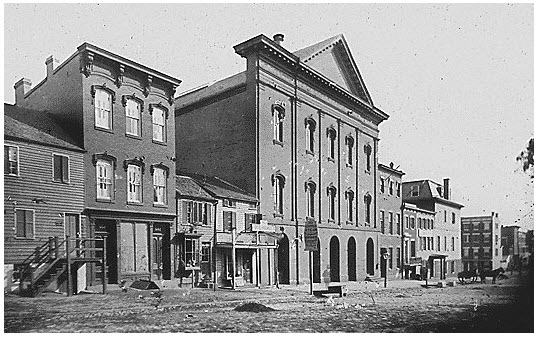
Ford's Theater Where Abraham Lincoln Was Assassinated |
Booth was part of a larger conspiracy that had planned the assassination of other government officials at the same instant, but Lincoln was the only one killed, though Secretary of State Seward was seriously injured in an assassination attempt. Abraham Lincoln's assassin then jumped off stage, breaking his leg, but he succeeded in escaping on a horse. The President was mortally wounded. He was taken to a house across the street now called the Petersen House, where he lay in a coma for a few hours before expiring. Abraham Lincoln was officially pronounced dead at 7:21 am on April 15 1865.
Booth was discovered hiding in a barn and was killed. Several other conspirators were eventually captured and hanged or imprisoned. Four people were tried by a military tribunal and hanged for complicity in the murder: David Herold, George Atzerodt, Lewis Powell (aka Lewis Payne), and Mary Surratt (the first woman to be executed in the United States). Three people were sentenced to life imprisonment (Michael O'Laughlin, Samuel Arnold and Samuel Mudd) and Edman Spangler was sentenced to six years in prison. John Surratt, tried later by a civil court, was acquitted. The fairness of the convictions, particularly that of Mary Surratt, was questioned and there are doubts about the degree of her involvement in the conspiracy.
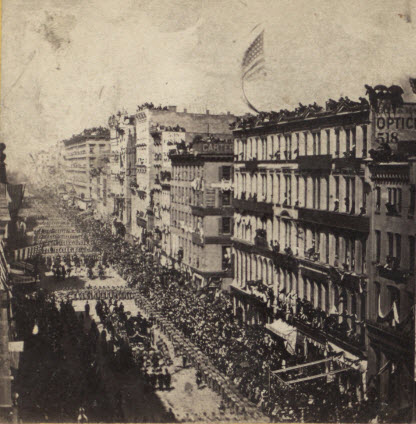 Crowds Watch the Lincoln Funeral Procession Through New York City, 1865 |
Lincoln's body was brought back to Illinois by train, with a grand funeral procession through several states. The whole nation mourned the man who many considered the savior of the United States, as well as protector and defender of what Lincoln himself called "the government of the people, by people and for the people." Some critics argue that it was the Confederates who in fact defended their right to self-government, and that the unity of states had been preserved at the expense of its voluntary nature. Lincoln has been remembered in many ways. Several U.S. cities are named after him, especially the capital of Nebraska. The Lincoln Memorial in Washington was erected in his memory, and he is depicted on the five-dollar bill, on the one-cent coin, and on monument of Mount Rushmore. Lincoln's Tomb and the Lincoln House in Springfield, New Salem (a reconstruction of the town where he lived early adulthood), the Ford's Theater and Petersen House are all places preserved as museums. |
On February 12, 1892 Lincoln's birthday was declared a federal holiday in the United States, though it was was later combined with George Washington's birthday and renamed President's Day. They are still celebrated separately in Illinois.
The submarine Abraham Lincoln (SSBN-602) and the aircraft carrier Abraham Lincoln (CVN-72) were named in his honor.
See also
- U.S. presidential election (1860)
- U.S. presidential election (1864)
- Lincoln's second inaugural address
- American Civil War
- Lieber Code
- The Lincoln Bible
- The Emancipation Proclamation
- The Gettysburg Address
- Mary Todd Lincoln
- John Wilkes Booth